Segment the universe first, determine your target audiences, and craft offers that appeal to those people. If you’re mostly worried about audience reach or how many devices are in your graph (whatever that is), you’re not marketing. Sorry.

Posted on by markpilip | Comments Off on Marketing: It’s About People

Advertising Needs More History Majors

In the United States in 2014, only 1.7% of the undergraduate degrees awarded were history degrees. In the period since 1971, the share of history and social sciences degrees has declined from 18% to 9%. 1

Why study history? According to R.G. Collingwood, Oxford philosopher,

“We study history in order to see more clearly into the situation in which we are called upon to act.”

An understanding of history is necessary to help us avoid making the same mistakes. Yet, as a society we no longer value the study of history. Everybody wants to get rich quickly, usually as a result of their “personal brand” or being on a reality TV show or as a Wall Street investment banker. (All pretty much the same thing.) So we get degrees in finance and leave the study of history to the musty old professors.

The result? When an advertising huckster comes along, pitching AI or machine learning, it all sounds great. The younger folks, with no exposure to past nonsense nor the inclination to look back in time, fall for it and add new things to the already gigantic advertising tech stack. Somebody gets rich, but it’s not the advertiser.

Those of us old enough to be exposed to history hear “AI” and “machine learning” and remember neural networks 2. We ask lots of inconvenient questions. The huckster leaves to look for more fertile ground. The advertiser keeps their money and stays on strategy.

With the constant bleat of “new” from well-funded startups that prey on the historically-challenged advertiser, is it any wonder advertising is such a mess? “XXX is dead” and “XXX% improvement” are storylines used for thousands of years and rejected by those successful enough to understand history–of their trade, of their nation, and of their civilization.

Takeaway: Hire some good liberal arts majors, particularly history majors. They know how to reason, how to write, and how to see if you’re being pitched some rehashed nonsense. And win.


———————
1 Dr. Niall Ferguson, October 28, 2016, quoting Julia Brookins, “New Data Show Large Drops in History Bachelor’s 11.Degrees,” Perspectives on History, March 2016, https://www.historians.org/publications-and-directories/perspectives-on-history/march-2016/new-data-show-large-drop-in-history-bachelors-degrees

Witchcraft that was purported to be better than logistic regression models back in the 90’s. Call me to discuss.

Posted in Leadership, Marketing, Philosophy, Strategy | Tagged , , , , , | Comments Off on Advertising Needs More History Majors

Fairy Tale: “Ads We Want to See”

One of the biggest fantasies shared by digital marketers and advertising technology providers is that people want to see ads. The problem isn’t them, it’s us. If only we installed more technology (and chipped away at privacy a little more), we’d improve our omni-channel results, they say.

This belief has been used to pile technology, algorithms, and nonsense on our marketing efforts. The first result is a supply chain that’s so opaque almost nobody can tell you why a particular advertisement was run. The second result is that adtech companies have made a lot of money by skimming your media dollars.

It’s a narcissistic delusion to believe that anybody cares about what we have to sell. There’s no magical technology solution that will make consumers* suddenly want to “engage” with our advertisements or our brands.

In the offline world, we always knew that our ads weren’t wanted. But they were tolerated, because they are part of the deal. We spent a lot of time making sure we got the targeting just right, put forth a compelling offer and did strong creative to catch the eye.

In the digital world, the focus is mostly on more algorithms and outright surveillance. How’s that working for you? How’s your signal to noise ratio look? Are you running ads on jihadi websites? Are you even showing ads to human beings? Are you sure?

Think the problem with digital advertising will be solved with more technology?

Takeaway: Segment your audience, select the target audiences, understand your allowable, craft compelling messages with stunning creative ideas, then decide which channels to use, and show your ads to people–not “identities.” Underpin all this with a core truth: Nobody cares about your product, your brand, or your ads.
And win.


*When I see the word “consumer,” my BS detector goes off. Mold, fungi, and insects are consumers. People buy our products and services.

Posted in Branding, Communications, Marketing, Media, Strategy | Tagged , , , , , , | Comments Off on Fairy Tale: “Ads We Want to See”

Answering critics

I’m as guilty as many marketers for taking certain key marketing assumptions as truisms, without doing the proper research to see if those strategic assumptions are based on data or mere belief.

One belief that I never accepted, however, was the old saw “it costs X times to acquire a customer as to retain one.” I knew from my years of experimentation as a continuity marketer that it wasn’t true. Acquisition was the entire key to growth.

This is a great post by Professor Byron Sharp, where he addresses criticisms of his fantastic textbook “Why Brands Grow.” And if you haven’t purchased the book yet and read it, please do so now.

ByronSharp's avatarMarketing Science

Our critics have been few, and rather kind (nothing of substance has been raised).

Now and then a marketing guru issues a thinly disguised advertisement for their consulting services that tries to have a go at the laws and strategy conclusions in How Brands Grow. They usually say something like:

“Our data confirms that larger market share brands have much higher market penetration BUT our whizz-bang proprietary metric also correlates with market share, and this proves that it drives sales growth, profits, share price, and whether or not you will be promoted to CMO”.

Often some obscure statistical analysis is vaguely mentioned, along with colourful charts, and buzzwords like:
algorithm
machine learning
emotional resonance
neuroscience

And sexy sounding (but meaningless) metrics along the lines of:
brand love
growth keys
brand velocity
true commitment
loyalty intensity

All of this should raise warning bells amongst all but the most gullible.

Let me…

View original post 1,159 more words

Posted in Uncategorized | Comments Off on Answering critics

67% of everything is mediocre (+/- one standard deviation from the mean) and 84% of everything is mediocre or worse.

Seems like 84% of the comments I see on social media start with “amazing” or “remarkable” or similar.

Heuristic: When you see “amazing,” assume the opposite and act accordingly.

Posted on by markpilip | Comments Off on “Amazing?” “Remarkable?” Actually, Not Likely

Twitter’s NYC Targeting Tribulations: Dunkin’ Donuts Edition

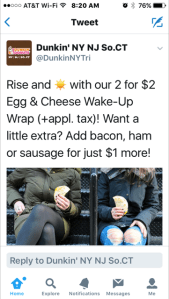
img_6945As usual this morning, I was blocking brands on Twitter that had the temerity to target me in a poor fashion. Meaning all of them. However, this ad from Dunkin’ Donuts of NY, NJ and Southern CT caught my eye.
Forget for minute that they have only 9,258 followers out of the millions of customers they have in the New York Tri-State area. Or that they only average 5.4 followers for each of the 1,700+ locations. Or that they’ve only received 1,545 “likes” for their Twitter efforts.

The problem with this effort starts with location. I’m not remotely near metro NYC and therefore had zero chance of buying breakfast this morning at Dunkin’ Donuts. But wait, it gets better. Continue reading

Posted in Marketing, Media, Social Media Marketing, Tactics | Tagged , , , , | Comments Off on Twitter’s NYC Targeting Tribulations: Dunkin’ Donuts Edition
screen-shot-2017-02-15-at-9-57-12-am

Thanks for the retweet!

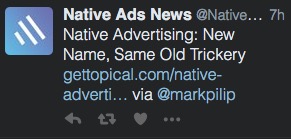
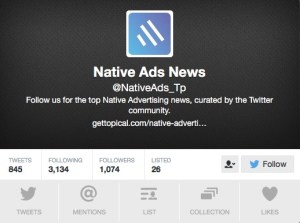
I ran a quick article on native advertising yesterday. Lo and behold, my article was picked up by a Twitter handle that tweets out positive news about native advertising.

Looks like the bot never read the article. Get some machine learning in there!


screen-shot-2017-02-15-at-9-57-01-am

You might have read it first, however.

Posted on by markpilip | Comments Off on Native Advertising: The Laughs Don’t Stop

Three Things I Learned From PewDiePie

screen-shot-2017-02-15-at-9-17-21-am

Uh oh. They caught me.

Influencer marketing and influencers “…will entrench as defining voices in consumer marketing, as brands concede advertising control and look to passionate brand advocates to sway consumers on social media.” Or so says “social media strategist” Stacy DeBroff.

I predict* influencer marketing will be just one more idea in the list of dubious concepts cast in front of ADD marketers by hucksters in search of a quick buck. It’ll be somewhere near “eyeballs, man, it’s about eyeballs” of the late 90s.

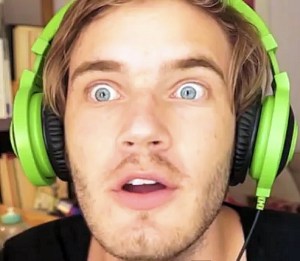
The problem with influencers is that, usually, they’re not. Unless you get a guy like PewDiePie, aka Felix Kjellberg. His huge following of 53 million subscribers, generating 14.7 billion views on YouTube sounds awfully tempting.

You’d want to take advantage of Google’s Preferred program and buy pre-roll video to reach that impressive audience, right? After all, Mr. Pie is very influential and his followers are bound to find that your products and services are irresistible when placed in proximity to him.

Except when he decides to run anti-Semitic videos full of hateful messages and imagery. And had to be dropped like a hot potato by Disney. Think they’re going to be looking carefully at everything they acquired in the Maker acquisition? And want to bet how much influencer marketing they’re doing with their valuable IP?

How do you think your brand equity would fare being seen before that type of “humor?” And if you have been conned into running influencer marketing campaigns, do you know how every one of those influencers is representing your brand? Have you–not your agency–read every word they’ve posted and watched every second of video they’ve uploaded?

Three things I learned from Mr. Pie:

  1. Never work with an influencer marketing agency. If you want to have an endorser of some kind, pick a couple and work directly with them. There’s no need to lose control of your brand to dozens of influencers who you don’t even know and can’t control.
  2. Read and watch everything. You may not pre-approve everything (although I highly recommend it), but you’d better be sure the association between the influencer and your brand is positive.
  3. Consider your brand equity. You’ve got brands that are worth, in many cases, billions of dollars. You wouldn’t give the keys to your car to somebody with a blog and a  YouTube channel. Why would you do the same with an asset worth orders of magnitude more?

Takeaway: Before you give control of your message and the context in which it appears to an “influential,” ask if you can’t get a better return by using one of the other many advertising channels at your disposal. Avoid bad brand association. And win.

*Very easy prediction to make. Read the nonsense here, which is just a taste of what the influencer marketing crowd is peddling.

Posted in Branding, Communications, Marketing, Media, Predictions, Tactics | Tagged , , , , , , , | 1 Comment

We used to call this stuff “advertorials.” It was easily identifiable, except to the most gullible reader, and was usually purchased by the most gullible advertiser.

The digital crew call it “native advertising” but it’s the same thing.

Two questions:

  1. If your advertising is so lousy that it’s not working, why do you think sneaking it into view is going to change the performance?
  2. Do you think so little of your target customer that they can’t see through the ruse?

Takeaway: Don’t fall for this digital flimflam. Make good ads. Place them in good locations. Become a marketer again. And win.

Posted on by markpilip | 1 Comment

Rise of the Bot: Organic Traffic is “Over”

crazy-people-don-8217-t-know-they-are-crazyOrganic traffic is “over” says Chris Tolles, CEO of Topix.

Usually, when I hear somebody from the online world say something is “over” I laugh. As we know TV is over (we spend 43% of our media time on TV and over 4 1/2 hours a day with live TV), radio is dead (only almost 2 hours daily with AM/FM radio) and so forth.

It’s usually just hype to get you to buy the next shiny object. But the Topix CEO’s claim is something entirely different. He’s gone on the record stating that the wave of the future for publishers is buying traffic.

That means he’s happy to sell you a heaping dose of bots. I’d argue mostly bots, especially if you’re lazy and don’t care to look too closely. Read the AdExchanger article linked above very carefully.

Take a close look at every site on which you purchase impressions. I wrote on this in December, with a quick checklist at the bottom.

Takeaway: You now have to treat every digital impression under the assumption that it’s not human. Fraudulent impressions are not the exception; they are the rule. Be skeptical. Very skeptical.

P.S. If you buy any digital media, I encourage you to read AdExchanger every morning. If you wonder why your working media percentage is so low, the gibberish you see on AdExchanger explains it. Pick a few of the terms and give your head of digital marketing a pop quiz some day.


Posted in Marketing, Uncategorized | Tagged , , , , , | Comments Off on Rise of the Bot: Organic Traffic is “Over”