Waiting Two Years–Why Most B2B Marketing Isn’t Marketing

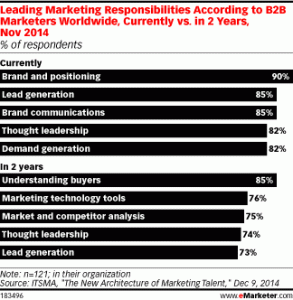
183496Today’s eMarketer update caught my eye with this startling graph.

This tells me that understanding the customer–at least among the B2B marketers surveyed–isn’t in the top five areas of responsibility. Further, although recognized as a need, it’s going to take two full years to get there.

What the….?

In a nutshell, this is why most B2B marketing is terrible and shouldn’t be characterized as such. In my experience, most B2B marketers with 10 years of experience have the same year, ten times. Sure, they do lots of marketing stuff and probably now do lots of social media stuff. (And have no idea why their “content marketing” doesn’t result in “conversations” about thermal control units, but I digress.)

The biggest sin that a B2B marketer can make is not knowing who the customer is. It’s a bigger sin than in the B2C world because with longer sales cycles and higher units of sale, small mistakes upfront can waste massive amounts of sales and sales engineering time. Plus, that doesn’t help with the historical levels of distrust between sales and marketing.

If you’re a B2B marketer and knowing the customer isn’t #1 on your agenda, fix it now.

Posted in Marketing | Tagged , , | Comments Off on Waiting Two Years–Why Most B2B Marketing Isn’t Marketing

Building Blockchains of Trust

I recommend this good article on how the concept of the blockchain (the root of cryptocurrencies like Bitcoin) works as a distributed database, improving trust and removing cost by eliminating the need for third parties.

I can imagine using this to lower cost and friction in online advertising, particularly in RTB–assuming the time lag problem can be fixed. Further, it eliminates the need for third parties that exist primarily to collect tolls. Many of the functions from entities like ICANN (domain names), Neustar (local number portability), RIAA/MPAA (media licensing) might no longer be needed, with the benefit of lower costs, better privacy and higher security.

I’ll be reading and thinking a lot more about the blockchain this coming year. How about you?

Posted in Organization, Privacy, Security | Tagged , , , , , , , | Comments Off on Building Blockchains of Trust

2014 in review

The WordPress.com stats helper monkeys prepared a 2014 annual report for this blog.

Here’s an excerpt:

A San Francisco cable car holds 60 people. This blog was viewed about 2,300 times in 2014. If it were a cable car, it would take about 38 trips to carry that many people.

Click here to see the complete report.

Posted in Uncategorized | Comments Off on 2014 in review

The Point of Education

The point of education is not to learn from a predetermined set of knowledge. Nor is it to learn how to learn or how to fish for yourself.

The point of education is to learn how to teach yourself.

Posted in Philosophy | Tagged , | Comments Off on The Point of Education

Stop Looking to Trade Up Your Employees

I often hear that companies are  “bowing to investor pressure” when shutting down lines of business or divesting business units, shedding thousands of jobs in the process. Or that investors “demand” outsourcing or offshoring strategies.

Nonsense. Nothing could be further from the truth.

We are confusing investors with traders. Wall Street bankers are not interested in the long-term value of your organization, your customers or your people (and yes, that includes you Mr. or Mrs. CEO). It’s just gambling, with the average share being held for 22 seconds or less.

When’s the last time you listened to a problem gambler for advice on how to treat interpersonal relationships? I thought so. So why would we listen to trader/gamblers for advice on how to treat our people?

We should treat our employees better than any other part of the organization. As a long-term investor would. That means training, development opportunities, correction when necessary and all coupled with a genuine concern for their well-being.

A true investor looks to improve the value of the asset and focuses on growing the value of that asset over many years, which includes investing in the asset. The trader treats everything like a disposable commodity and is always looking to trade up.

How will you treat your employees this Q4?

Posted in Leadership, Organization, Philosophy | Tagged , , | Comments Off on Stop Looking to Trade Up Your Employees

Sales: Where the Rubber Hits the Road

I’ve seen a lot of articles how Black Friday sales are down around 11% YOY this year. The decrease has been attributed to moving  the sales forward earlier in the week or the increased importance of online sales.

What I haven’t seen is how social media “conversations” with brands might have changed purchasing patterns. Nothing at all about how those relationships with brands have moved our purchases to or from a particular retailer or brand.

As always, it’s all about saving a buck. We’ll keep our relationships to the things that really move us–friends, family or maybe cat videos. The next time a social media charlatan tries to get you to invest in a megabucks “relationship” campaign, boot them and invest the money in good old-fashioned advertising and promotion. Your bottom line will thank you.

Posted in Marketing | Tagged , | Comments Off on Sales: Where the Rubber Hits the Road

OODA Loops for Incident Response, Marketing, and Communication…

Succeeding in cybersecurity means getting inside the other guy’s OODA loop. Good essay by Bruce Schneier.

I’ve used the OODA loop (mostly) accidentally and intentionally for years. Here’s how you can apply it to multichannel marketing.

Why not “get inside the other guy’s OODA loop” when communicating, particularly in the combative corporate environment? Hmm. Might be more to write about here.

Posted in Communications, Security | Tagged , , | Comments Off on OODA Loops for Incident Response, Marketing, and Communication…

Rediscovering Direct Mail

I get a kick out of articles like this one. The BBC author appeared surprised that A/B testing for marketing was invented–I’d say perfected–in direct mail. I guess us old dogs are responsible for some “new” tricks after all!

Takeaway: Sometimes it is easier to learn by looking to the past than by trying to guess the future.

Posted in Direct Response, Marketing | Tagged , , , | 2 Comments

Questions Advertisers Should Ask of AT&T and Verizon

It turns out that you’re not just a product when using free Internet services. Even when you’re paying AT&T and Verizon for cellular service, you’re still being productized by having your communications altered without you knowing about it.

Both Verizon and AT&T admit to injecting a cookie-like tracker without your knowledge or consent into your HTTP request. A good summary of how it works is here. Thanks to Bruce Schneier for making me aware of this.

Here’s the question for advertisers. If you choose to respect the Do Not Track request, what do you do if you use Verizon’s Precision Marketing Insights? Is Verizon (and AT&T, once they launch their equivalent) passing along the DNT flag as well? Or are they stripping out records that have DNT enabled? And if they say they are, are they actually doing it?

As ethical advertisers, we need to consider the source of the data, how it is collected, the lineage of the data and what the consent and intent was of the person generating the data. Now intent can be hard sometimes. However, the other questions should be asked by us as marketers.

Takeaway: Don’t accept “don’t ask, don’t tell” when it comes data and leave the hard questions to the technical folks or the legal team. Understand where the data is coming from and how and why it was collected before you use it.


Posted in Data, Marketing, Philosophy | Tagged , , , , , | Comments Off on Questions Advertisers Should Ask of AT&T and Verizon

K.I.S.S. Your Copy

Glam Red gloss lips.You have less than one second to convey your USP and offer. Only give them:

  • One price
  • One simple USP

If you can’t, you’ll never have them ask “what else can I buy from you?” and you’ll never have the chance to say “here’s what else I have for you.”

Posted in Communications | Tagged , , | Comments Off on K.I.S.S. Your Copy