Would You Fire Your Children?

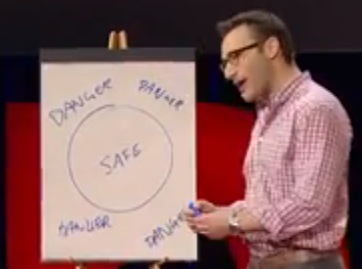
The Circle of Safety

The Circle of Safety

I certainly hope not.

Yet how many executives who speak of their company as having a “family” atmosphere think nothing of sacrificing that same family when the numbers are a little short. Oh, it’s explained using all the right terms, like rightsizing or aligning expenses with revenues.

But the instant you do it as an executive, you not only show yourself to be insincere but also a liar. Because you’d never fire your own child when he or she came home with a low grade. Nor would you even think about eating until you were sure the kids and your spouse had enough.

For some reason, we allow our executives to develop corporate values statements or mission statements that refer to family values, and then turn around and destroy those very families when Wall Street might be a little disappointed with the quarterly earnings. Of course any pangs of guilt felt at throwing people out of work are assuaged by bonuses and stock price increases.

I’m very clear here–it’s not the corporation that’s at fault. It is the executives that choose courses of action that allow them to send their children to private schools, while the families of the downsized are forced to rely on charity so their children might simply be clothed. No corporation ever gutted a town to shift the labor offshore to a place with questionable safety and environmental policies, just to save a few bucks in labor. Corporate executives–people–developed, championed and executed 100% of those plans.

If we are to be seen and recognized as true leaders, we need to be create a reality where our people feel safe. Only when they feel safe, can they contribute unhesitatingly and completely to the enterprise. Only when our team knows that we have their back, will they be able to look outward. Toward the customer, the competition and the opportunities for the future.

That means, as a leader, you might have to take a smaller bonus from time to time. Or be castigated by Wall Street. You might even pay with your own job. But wouldn’t you do it protect your team? After all, they’d do it for you, right?

Inspired by Simon Sinek’s latest talk:
 

Posted in Career, Leadership, Philosophy, Strategy | Tagged , , , , | 3 Comments

Bottom-Up P&L

I was looking for a file this morning and stumbled across a P&L sensitivity model I built in 1998.  I built the model while working for the continuity marketer International Masters Publishers, where I learned  (and eventually taught) proper direct response marketing.

The most interesting thing about the model? It didn’t bother to model revenue, only profit. The model allowed the user to adjust assumptions to locate the best compromise between maximizing profit and maximizing marketing efficiency (ROI).

Takeaway: When you understand your business so well you can build P&L from the bottom up, you’re on to something!

Posted in Direct Response, Marketing | Tagged , , , | Comments Off on Bottom-Up P&L

My Morning As A Product

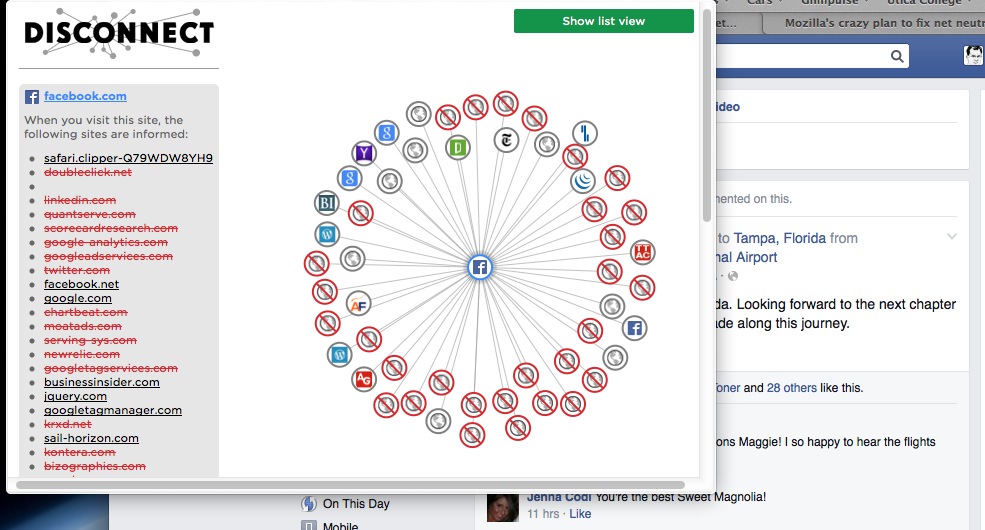
Screen Shot 2014-05-06 at 8.02.03 AMI’ve been tracked over 700 times in just 5 minutes.

That’s not including what the NSA is tracking about me. It’s just the count of the number of times Facebook has “called home” to various tracking services in the few minutes I spent this morning over coffee seeing what my friends have been up to.

The image in this article shows the Disconnect browser plug-in visualization of what sites are informed when I visit Facebook and which ones have been blocked. It is amazing how many times Facebook attempts to send back data when I look at photos or “like” things to sites like:

  • Skimresources.com (Don’t like the sound of that one)
  • Newrelic.com (I’m not that old yet)
  • Krxd.net (Sounds like a new type of bath salts)
  • Ooyala.com (Was the “oohlala.com” domain taken?)

Of course, my data is being shared with those sites to enable Facebook to create advertising revenue. But exactly what data? And what are those companies–many of them open-plan startups with who-knows-what security–doing with the data they are receiving?

I also took a look at my Ghostery settings and noticed that they currently enable blocking of:

  • 963 advertising trackers
  • 306 analytics trackers
  • 376 beacons
  • 16 privacy trackers
  • 273 widgets

Unfortunately, I was allowing hundreds in many of those categories, as my Ghostery settings weren’t up to date. Now, many of those those trackers don’t matter. I found that Gazprom (Russia) has an advertising tracker. Who knew? But unless I’m visiting Russian sites, the impact on my privacy is zero.

Why all these trackers? Simple. I’m (and you are) a valuable product that Internet publishers can sell to advertisers. In many cases, I’m OK with that. I’m a marketer and love to be sold to. I love great advertising. And in certain categories, I’m a dream customer.

I’m just not interested in my information being sent all over the place.

What can you do about it?

Not much. As the saying goes, if you’re not paying, you’re the product. What you can do is install some tools and see who’s tracking you and then you can decide if you want to be tracked (at the risk of disabling website functionality) or where you want your information sent. Try:

Install them in your browser and take a few minutes to see where your information is going and then adjust the settings to make you more comfortable. Will any of these tools give you perfect privacy? Of course not. But you’ll be a little less of a product.

Posted in Analysis, Data, Media, Privacy, Security | Tagged , , , | 1 Comment

Owning a Position

You can–and should–start with your “why.” Know what your organization stands for and communicate that. But if you want to own a position in the customer’s mind, there’s only one way.

Put out a product that does it.

Shipping > four box grids.
Shipping > fundraising.
Shipping > strategy.

Shipping wins.

Posted in Marketing, Philosophy, Product Development, Tactics | Tagged , , | Comments Off on Owning a Position

Don’t Be Blind To Domain Dependence

Hear no evil, speak no evil, see no evilWhy did the auto dealers in New Jersey work to get Tesla’s direct sales model banned in the state?

Why do Uber and Lyft have to battle taxi and limousine commissions in order to do business?

And why didn’t Hilton or Marriott start Airbnb?

One of the reasons is domain dependence, something Nassim Taleb covered in Antifragile. As humans, we tend to see things framed through our own experiences. And, as humans, we can’t experience very many things in relation to the opportunities available to us. So to an auto dealer in New Jersey, Tesla looks like an attack on their business model, while Uber and Lyft scare T&LC’s who fear loss of regulatory power and large hotel chains can’t understand why people would rent their homes to total strangers.

The old adage “when all you have is a hammer, everything looks like a nail” is essentially what domain dependence is. Only in reality we don’t know the thing in our hand is called a hammer and that the thing we’re looking at might be a grapefruit. That’s because we have no familiarity with the concept of a grapefruit, because it’s never been in our domain to experience.

What’s the risk of domain dependence? You either miss a growth opportunity or get blindsided more quickly than you can react with either new products or regulations from your bought- and paid-for politicians.

Ideas for developing immunity to domain dependence:

  • Hire people from outside your industry. Sure, Marriott wants CMOs and CPOs from the hotel industry. But what if their product and marketing people had backgrounds from companies that relied on crowdsourcing for product ideas? I don’t think they’d have beaten Airbnb to the punch, but they may have reacted more quickly.
  • Hire for attitude and learning speed. Bring in people from outside your industry. Even if they don’t know much about what you do today, if they can learn quickly, they’ll figure out what you do and then add their novel experience. Your company’s domain can only get larger, which is a good thing.
  • Consciously exit your domain. Stop going to your industry’s trade shows. Only read the industry rag once a week. You’re already an expert in what you do, right? So study some other fields. Could they help you today? Who knows. But you’ll be more likely to notice that you have a hammer in your hand before you swing it at that grapefruit.


Posted in Career, Diversity, Education, Leadership, Organization, Product Development | Tagged , , , | Comments Off on Don’t Be Blind To Domain Dependence

What’s Up With WhatsApp?

I haven’t had a lot of time to think about Facebook’s acquisition of WhatsApp. But my former IMP colleague Larry Solomon has been thinking about it. He recently emailed to ask my thoughts, which are published on his blog here.

Posted in Uncategorized | Tagged , , | Comments Off on What’s Up With WhatsApp?

ID Theft – Be Always Diligent – Lesson from My Accountant

Good reminder from Mark Goldstein during tax time.

infoguardianangel's avatarSafeSecurePrivate

I am always careful of what information I give out. When the DMV was asking me for my Social Security number to put on my license I protested. Why does the DMV need this info? After a letter writing campaign, the DMV switched to a new ID system. When my health care provider sent me an ID card with my SS# on it I protested.  I was happy to get their first “fake-o” ID card as they called it. If there isn’t a good reason to give my info to you I will not give it.

I just filled out my tax return for my accountant. He looked it over and asked why am I putting the full account number of my financial institutions on my tax form. Good question. The IRS computers can match my tax return and my account info. Why put the full number on the form…

View original post 51 more words

Posted in Uncategorized | Comments Off on ID Theft – Be Always Diligent – Lesson from My Accountant

What happens when everyone is a part-timer?

I’ve tried to live my business life following the adage “If my neighbor doesn’t have a job, sooner or later I won’t either.”

I believe that strong communities exist when there is mutual respect, free exchange of ideas (good and bad), a sense of safety and diversity of all types.

When I say “safety” I mean the very basic levels. The ability to provide food, shelter, and clothing for one’s family. That means good jobs that pay decently and have a modicum of security during turbulent times.

Decent jobs doesn’t mean living in fear that your position will be turned over to a freelancer at $10 per hour or outsourced to a semi-qualified temp halfway around the world. It doesn’t mean that you’ll be cut at the end of a quarter just to balance the books and justify the CEO’s bonus. It doesn’t necessarily mean making $100K or more, either.

Does that explain in part–although I can never condone violence–why taxi drivers in Paris are attacking Uber drivers? As Salon’s recent analysis of the situation put it:

What happens when everyone is a part-timer?

How safe do people feel when their existence boils down to how quickly they can get to an Uber hail? How will the rent be paid and the kids be fed if the driver is a little slow off the mark? Even if he gets the hail, what if the kids get sick? There’s no health insurance in freelance nation.

How safe should pedestrians and the rest of us feel? You see, if I don’t feel safe, I can’t help others feel safe. I’ll do anything I can to look after number one, even if that means potentially hurting others. Nothing personal, it’s just how biology works.

I’m not an expert in building technology-driven business models. But I know this to be true:

If my neighbor doesn’t have a job, sooner or later I won’t either.

Takeaway: Build value by extending the circle of safety to more people in your community, not by taking it away.

Posted in Behavioral economics, Leadership, Marketing, Media, Philosophy | Tagged , , , , , , | Comments Off on What happens when everyone is a part-timer?

2013 in review

The WordPress.com stats helper monkeys prepared a 2013 annual report for this blog.

Here’s an excerpt:

A San Francisco cable car holds 60 people. This blog was viewed about 2,800 times in 2013. If it were a cable car, it would take about 47 trips to carry that many people.

Click here to see the complete report.

Posted in Update | Comments Off on 2013 in review

They still publish phone books

20131224-080230.jpg

Yellowbook has a strange business model. It goes like this: you sell ads to companies that don’t fully realize the Internet has been invented, then chop down trees and pulp them into little books. Then, waste a lot of gas and litter them all over the place–including shopping malls–and let the recipients pay to dispose of your litter.

Sounds like a model for growth, for sure!

More soon-to-be recycled books:

20131224-080647.jpg

Posted in Analysis, Communications, Marketing | Tagged | 2 Comments