
Black Friday Narrative: The Retail Apocalypse (The Data Says…)

Screen Shot 2017-11-21 at 8.52.39 AMI was searching Linkedin last evening and read a comment from somebody about how “Black Friday sales have been down the last few years.”

The comment came with no facts to back the assertion, and it fit neatly into the “e-commerce is causing a retail apocalypse” narrative that we’re seeing and will see when the weekend sales are written up on Monday morning. I thought the comment might have been lazy acceptance of a story, so I thought it was time to do my own research.
Screen Shot 2017-11-21 at 8.58.23 AM
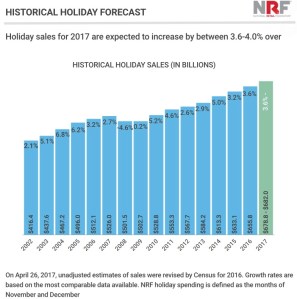
First, retail holiday season retail sales are continuing to increase, per the NRF with their forecast for this year pegged at a gain of 3.6 to 4% as compared to last year. OK, maybe the NRF has an agenda, as they are an association of retailers who generally stand to lose if online sales continue to grow.

If you’re going to grow the quarterly sales, you’re going to do it on Black Friday, when a substantial fraction of all Q4 sales are made.

I figured that online sales were probably growing a lot more quickly than offline sales, if my own household’s expenditures are any indication. (Of course, that’s n=1, always a red flag.)

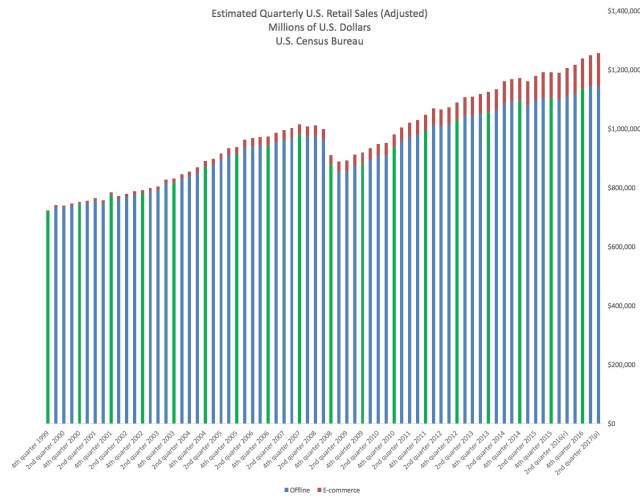
So I took a look at the data from the U.S. Census bureau, which tracks seasonally adjusted retail sales, and splits up those sales between e-commerce and traditional retail. Do they have the breakdown perfect? No, but it’s probably directionally correct. Here’s what the quarterly data looks like. I’ve highlighted the traditional retail Q4 sales in green.
Screen Shot 2017-11-21 at 8.50.29 AM

You’ll notice that that the size of the red bar–the online sales–is indeed increasing rapidly, particularly in the last few years. Going back to Q4 2011, here’s maximum, minimum and average QoQ growth rates:

  • All retail:  Max 2.4%, Min (1.0%), Average .9%
  • Offline: Max 2.3%, Min (1.3%), Average .7%
  • E-commerce: Max 6.0%, Min 1.7%, Average 3.5%

Over the same period (going back to Q4 2011), the YoY changes for ecommerce have averaged 14.7% and been as much as 17.6% (Q4 2011 vs Q4 2010). There is no question that ecommerce sales (Amazon) will continue to grow dramatically, aided by Amazon’s increasing ability to cross-subsidize from the AWS business and the advantages of not needing to collect tax in many municipalities.

But there’s something about rapid growth from a small (zero) base. Here’s how much of your retail dollar is spent online for the holiday quarter, going back to 2011:

  • Q4 2016: $0.08
  • Q4 2015: $0.07
  • Q4 2014: $0.07
  • Q4 2013: $0.06
  • Q4 2012: $0.06
  • Q4 2011: $0.05

Different than the “sky is falling” narrative, isn’t it? My guess is that the share of holiday spending spent online this year as compared to last year will increase once again by 14-15% as it has the last several years. But that still means that >90% of everything sold in the U.S. will come out of a brick and mortar store in Q4 2017.

Black Friday isn’t dying, even if it’s becoming less important. Retail isn’t dead, even if the narrative says so. And customers still like to touch a lot of what they buy, before they buy it, even if that doesn’t fit the tech narrative.

Takeaway: When you see easy stories, question them. Do primary research. Run your own numbers. Draw your own conclusions. And win.

Posted in Data, Marketing, Media | Tagged , , , , | Comments Off on Black Friday Narrative: The Retail Apocalypse (The Data Says…)

Screen Shot 2017-11-16 at 8.29.00 AMNext week, as you’re doing your annual IT work for parents, in-laws, aunts and uncles, take a few minutes and talk about protecting privacy and improving their cybersecurity.

This Motherboard article, recommended by Bruce Schneier, is a great place to start. Will it provide perfect privacy and security? No, but it’s a good start for your loved ones.

At a bare minimum I recommend:

  • Installing an ad blocker (yes, I’m a marketer and yes, I use one)
  • good paid VPN on both desktop and phones
  • Removing personal information from social media such as birthdays and “likes” of topics which can de-anonymize you (which means everything)
  • Change social media default post settings to friends only
  • Encrypting the hard drive
  • Update the OS and applications
  • Install (or use) a password manager

You can do the above during the end of the Lions game and still be finished in time to catch the Cowboys.

Happy Thanksgiving!

Posted on by markpilip | Comments Off on Thanksgiving Project: Security and Privacy

GroupM Shines Light on Middlemen

Screen Shot 2017-11-15 at 8.01.55 AMBravo to Group M for starting to shine the light on the adtech middlemen who reduce our working media to, at times, a pittance. Advertisers need to demand more of this behavior from our agencies. Here’s the report I want for every publisher and every placement, for a hypothetical $100 spend:

Net to publisher*                   $30   30%
Agency fees, variable            $10   10%
Agency fees, fixed                  $ 2     2%
Ad tech 1                                  $10   10%
Ad tech 2                                  $10   10%
etc.

Summing to 100%. Once you, as the advertiser, understand this exactly, you can begin looking at the best ways to slim the ad tech fees through a testing program. I’ll bet some of the tech you’re using either doesn’t work or can be renegotiated to a significantly lower rate.

Takeaway: If the supply chain isn’t transparent to you, you’re being taken. Demand proper accounting of how your dollars are being spent. Study the reports and test to see what value is added by each vendor. And win.

* Your agency agreement provides for no kickbacks to your agency, right?

Posted in digital marketing, Marketing, Media, Philosophy, Tactics | Tagged , , , , , , , | Comments Off on GroupM Shines Light on Middlemen

Want Salient Fake News? Next Gen TV is the Ticket

Prediction: If you think it’s easy to use social media advertising to–I don’t know–sway elections via (small) bags of rubles, wait till you see what we get pumped into our homes via Next Gen TV.

Full-motion, beautiful imagery, and powerful, targeted messages. Very profitable, of course, totally fake, and basically unregulated by anybody.

Takeaway: I’m not sure anymore.


Posted in Predictions | Tagged , , , , | Comments Off on Want Salient Fake News? Next Gen TV is the Ticket

Paywalled, but interesting article at New York Times today on Renee DiResta’s work on peer-to-peer disinformation and how social media can be gamed to lead one into an echo chamber where vaccines can cause autism, planes distribute chemicals via chemtrails, and where an election can be influenced.

It got me thinking about peer-to-peer disinformation in the adtech and martech world. How much of what we hear as “real-life results” is just the sound of BS echoing off the walls? And how do you avoid being influenced by disinformation?

Posted on by markpilip | Comments Off on Peer-to-Peer Disinformation

Looks like some of the shady players in adtech (a large group from which to choose) are resorting to social engineering to get around ads.txt. What should you add to ads.txt? Nothing.

By the way, I think an ads.txt file can be a sign of desperation and point you to sources that you should monitor for fraud more carefully. Check out Salon.com‘s. Wow. As I write this, even the hinky Thrive Plus is in there.

Posted on by markpilip | Comments Off on Adtech Social Engineering

ABD (Always Be De-Averaging), ads.txt Edition

Screen Shot 2017-11-01 at 8.42.54 AMNow that ads.txt is getting traction, with about 44% (and growing) of the top 10,000 domains using it, you’ve got some homework in your future.

Here’s the assignment: Pull together your campaign data at the source (e.g. somedomain.com) and “source/source” i.e. where you actually bought the inventory. At the source / source/source level gather the following:

  • Impression volume
  • Clicks
  • Costs
  • Attributed sales (both MTA and last-click)
  • Attribution source (view-through, click-through)
  • Fraud data from your fraud vendors
  • Time-of-day data for impressions and clicks

I hope you can see where this is going: You’re now going to check to see which of the authorized sources for publisher data are playing fast and loose with what they’re selling you. You might see it in CTR index rates that are ridiculously high, odd distribution of impressions in the middle of night, and so on.

Two, pre-coffee hypotheses occur to me:

  • The more authorized sources in a publisher’s ads.txt file, the greater the likelihood that you’ll see source/sources with bizarre-looking metrics and higher fraudulent traffic.
  • The more heavily you optimize for CPM at the publisher level, the more likely your dollars tilt toward the sketchier–but still approved–resellers.

You’ll have your own hypotheses that will vary based on your digital buying strategy. And I think the above hypotheses will be easier to see when you split out your analysis at display vs. video.

As a fellow CMO is fond of saying “The average is a lie.”

Takeaway: Always de-average, even if it takes a long time. Make sure you collect your data in a way that allows you to de-average, even if it takes a long time. This will cost money, which is OK. Then, ABD (Always Be De-averaging). And win.

P.S. Coffee’s kicked in. Check my post on source level triage for some tips on how to use your findings.

Posted in Analysis, Data, digital marketing, Marketing, Media, Tactics | Tagged , , , | 1 Comment

Where’s the Bottom of the Barrel?

Screen Shot 2017-10-31 at 8.59.37 AMThis quote from an un-named programmatic specialist at a media company is telling:

If you want our $1 to $2 inventory that’s on the open exchange, we’re glad you are interested in it, but you aren’t going to get much value out of 300 x 250 display ads at the bottom of the site.

In other words, the stuff the doesn’t get sold direct or via PMP is the dreck.

Should you still buy programmatically? Sure, as long as you know what you’re buying and that what you think you’re buying is what you’re actually buying. (These are two very different things.)

But make no mistake about it–the ad tech world is in the business of creating ever-bigger barrels with more gunk at the bottom.

Posted in digital marketing, fraud, Media | Tagged , | Comments Off on Where’s the Bottom of the Barrel?

Screen Shot 2017-10-24 at 10.55.13 PMOut of nowhere, something appears on your radar. You’re not sure how long it’s been there.

You can get upset that you never noticed it before, because it might have changed the last decision.

Or you can acknowledge that you now have new information, which might change the next decision.

Posted on by markpilip | Comments Off on On the Radar

Continuity Marketing: Profit or Scale?

Screen Shot 2017-10-24 at 8.48.38 AMI had an interesting discussion on continuity acquisition strategy yesterday, which boiled down to two questions:

  1. Do we spend profitability, at break-even, or to penetrate (i.e. at a loss) at the margin?
  2. By profit, do we mean gross margin, marketing contribution, or some other measure?

These are great questions that the leadership team of your company, whether a start-up or established player, must agree on when finalizing strategy and building business models. When you start acquiring customers it’s too late to decide, as the systems and people required to optimize for scale or profit are different.

I’ve worked in both the “maximize for profit” and “maximize for scale” types of continuity businesses. In the former, I could optimize performance at a detailed level and forecast customer growth and profits with a high degree of accuracy. However, if I suddenly had to spend more than a couple of million dollars to take advantage of an opportunity, it was difficult to do so. In the latter, I could act on tens of millions of dollars of contingency spend in days, but profitability at the margin was hazy and customer counts were harder to predict with accuracy.

Both systems are OK. You just have to decide what you want.

If you’ve got a business with relatively high fixed costs, and the product has some acceptable substitutes, there’s no question in my mind that you have to go for scale and get big fast. That means acquiring customers on the margin that are unprofitable.

Unprofitable customers? Why?

Four reasons:

  1. You have a larger pool to test with. You have more inquiry non-buyers (INBs) to test with, seed models, etc. You’ll also have more cancels with which to get expert on winback and reach-back marketing.
  2. You’ll have more data on customer usage. You’ll be able to figure out what features the best and worst customers like and don’t like and increase the speed at which you can feed your product development organization with good data.
  3. You can turn on more profit more quickly. It’s easier to defray your fixed costs over 10 million rather than 1 million subscribers. You’ll also know exactly where to put the next dollar to generate more profit.
  4. Your competitors are going for scale too. Therefore it’s important to get inside their OODA loop. If they learn faster than you, you’re cooked.

I’ll leave it to you, your CFO, and your investors to decide when it’s the right time to move to profitability and how you define it.

Takeaway: Agree on your marketing strategy before building your marketing platform. Understand what “profit” is, and how much you need at the margin. Scale quickly. And win.

Posted in Direct Response, Marketing, Philosophy, Strategy, Tactics | Tagged , , , , , | Comments Off on Continuity Marketing: Profit or Scale?