Extending the Circle of Safety Today

As we look forward to the weekend, let’s look back. As a leader did you:

  • Clarify your organization’s “why?
  • Bring others who shared your values into your organization, and not just those who had the skills you wanted?
  • Extend the circle of safety inside your organization?

If not, can you do that next week?

Posted in Leadership | Tagged , , , | Comments Off on Extending the Circle of Safety Today

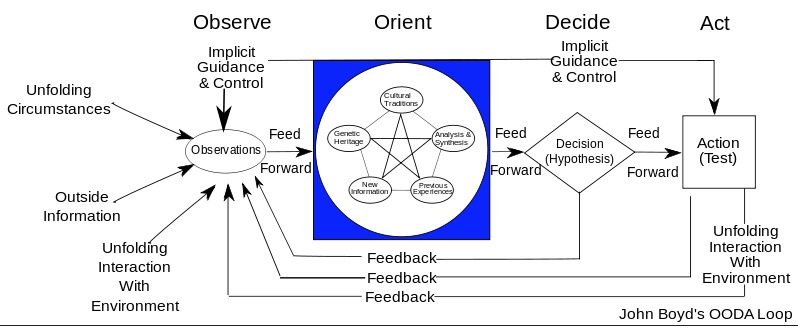
Whiffletrees and the OODA Loop

The OODA Loop

The OODA Loop

Sounds like a barbershop quartet and a fad from the 1950’s, doesn’t it? As I promised on Tuesday and finally got around to today, here’s the concept of using a whiffletree to manage your multichannel marketing.

You might think that with more marketing investment moving to digital, with an attendant increase in our ability to read results in real time, that we could automate the allocation of marketing spend across channels. In other words, have machines do digitally much faster what we humans can’t do.

I disagree. We must instead use the technology, but operate in an analog fashion.
Continue reading

Posted in Analysis, Marketing, Organization, Tactics | Tagged , , , , , | 6 Comments

Your Customers Are Not Consumers

Kudos to Unilever’s CMO Keith Weed for starting to banish the word “consumer” from the marketing vocabulary. Molds, fungi, and bacteria are consumers. People buy your products and services.

In a talk at Cannes today, he discussed Unilever’s marketing transition from targeting to serving customers. He described it as moving from “marketing to consumers” to “marketing with people” to “marketing for people.”

That’s a terrific move because it recognizes the importance of social media on our marketing efforts. Further, that phrase tells the marketers and agencies working with Unilever what’s important: the centrality of the customer.

This concept also works in B2B marketing. Just because the check comes from a large corporation doesn’t mean the decision makers aren’t people. It certainly beats the alternative, treating the customer as a “kill” which I discussed last month.

Takeaway: Don’t dehumanize your customers by equating them with bacteria. Build your marketing with people at the core to win.

Posted in Branding, Communications, Marketing | Tagged , , , , | Comments Off on Your Customers Are Not Consumers

Improve Your Multichannel Marketing With a Whiffletree

whiffletree

Whiffletrees, also known as Whippletrees.

Some of the digital natives out there might think of us old direct mail guys as being in the buggy whip business. Fair enough. It may be hard to see what mail has to do with retargeting, programmatic media buying and so forth. But there’s at least one thing a multichannel marketer needs.

The whiffletree.

And if you don’t have one, your multichannel marketing isn’t going to operate optimally.

What’s a whiffletree and why do I need one? More tomorrow. But first, watch this video which shows how you can use a whiffletree to create a digital to analog converter.

Posted in Marketing, Organization | Tagged , , , , , , , , | 1 Comment

Forget Big Data. Improve Marketing With a Cathode Follower!

Fender EC Vibro-Champ Amp

Fender EC Vibro-Champ Amp

What do tube amplifiers have to do with digital marketing?

It turns out the analog world of tube circuits is more like the real world of marketing and advertising than the clean, digital, “Big Data” world we’d like to believe we operate in.

Give me just a minute to explain.

First, Thank You to Uncle Doug!

Continue reading

Posted in Communications, Guitar, Marketing, Organization | Tagged , , , , , , , , | 1 Comment

Remember D-Day

Omaha Beach Gallery, First Division Museum at Cantigny

Omaha Beach gallery of the First Division Museum at Cantigny. Wheaton, IL. Photograph by Michael Linden, Flickr.

It’s pitch black, 00:16 hours and you’ve just crash-landed near Caen. You’re in hostile territory, lost, and some of your comrades are already dead and wounded. You’re just 20 years old and have never been in combat.

So began D-Day 70 years ago today.

I can’t imagine what it must have been like.

Over 180,000 young men jumped, landed, or waded into Europe to remove the evil and tyranny that gripped much of the continent for so many years.

Those young men didn’t consider themselves heroes. They were there to do a job that needed to be done. They hoped that when the job was done, they would go home to begin their lives.

Some never made it.

You may see some increased media coverage of D-Day because of the anniversary. But there’s not many left who remember how important today still is.

We should never forget this day, nor those who did their job. I won’t.

Today is D-Day.

Posted in Leadership | Tagged , , , , , , | Comments Off on Remember D-Day

Price-Driven Corporate Brutality?

4111133975_f7c81d8869_oThe quest for the bottom line leads to brutality, says Seth Godin in today’s blog post.

The race to the bottom, driven by price, causes people within companies to treat others with disregard of the Golden Rule. Outsourcing, treating customers with contempt and treating suppliers with contempt results in those organizations extending that behavior in their own companies.

It’s a really interesting theory and it reminded me of something I saw first hand.

One evening I walked into the inside sales bullpen of a medium-sized company. I saw the following on the whiteboard where the daily sales goals were tracked:

How many kills did you make today?

When you refer to your own customers with that kind predatory language, what type of behavior does that engender?

It turns out that it was the culture of price that drove the “kills” comment.  The salespeople were working in a very competitive environment and the number one complaint they had was about the price. The products they were selling were priced at a higher price than the competition. But rather than sell on quality, the salespeople wanted to sell on price. Their management (not leadership!) hadn’t prepared them to do anything else.

The brutal “kills” comment was just a manifestation of wanting to compete on price. By the way, the salespeople were treated as prey by their management and treated their colleagues in a similar fashion. The customers? Well they were just so much carrion to be picked over–and the customer complaints told a story of unbelievable contempt toward them.

Maybe the race to the bottom does lead to brutality. Even the unchecked desire to participate in a price war may lead to bad behavior. What do you think?


Posted in Customer Care, Leadership, Organization, Sales | Tagged , , , , | 1 Comment

The Only Five Arrows That Matter for The New York Times

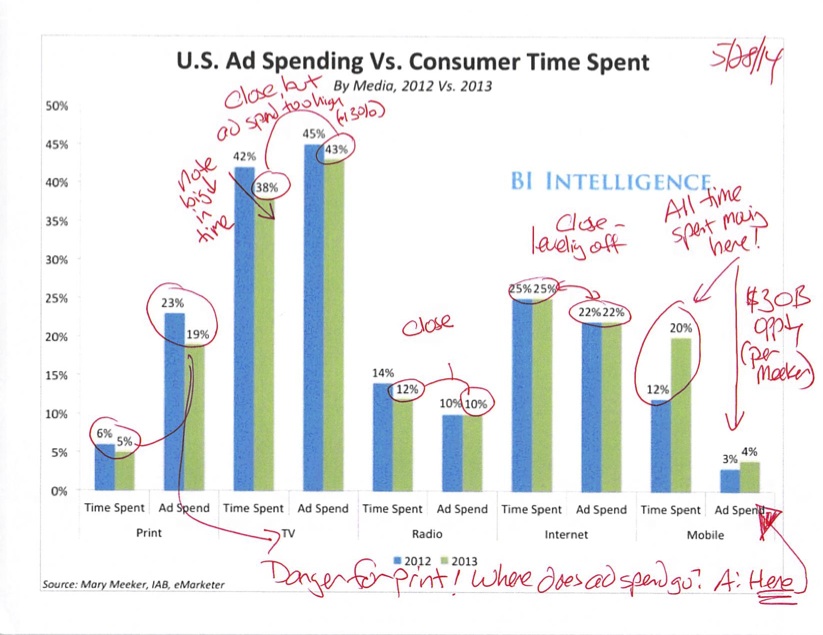
US Ad Spending vs. Consumer Time Spent, 2012 vs 2013

This graphic from BI Intelligence showed up in my email yesterday and I took the time to scribble all over it. (I tend to think with a pen in hand.)  I found it relevant to my recent post about the New York Times Innovation internal report.

The problem for the New York Times lies in the two leftmost sets of bars. Notice how time spent with print is down to 5% of our media consumption time in the United States, yet 19% of advertising spending is still directed to print?

The bars will never always align completely, as people are always shifting media habits to new channels and new forms of entertainment. But what I’m certain will happen is that the advertising dollars will shift to mobile. Per Mary Meeker’s recent Internet Trends deck (a must-read), that means about $30 billion in advertising spend should start flowing to mobile.

The chart demonstrates that most channels are reasonably aligned in time spent vs advertising dollars. So it’s clear that the dollars will flow largely from print to mobile. That’s what’s out of whack. Yes, you can argue that the time spent with print is of higher quality than looking at cat videos on your mobile device. But even if print time is double in value, then 10 percentage points of advertising still has to flow somewhere.

And, this graph only shows 2012 and 2013. The time spent in print certainly isn’t going up and to the right.

What should the Times do about this? Well my thoughts are here. Importantly, there should be a rabid focus on mobile. Because that’s where all the money in print advertising is going.

Posted in Analysis, Branding, Marketing, Mobile, Strategy | Tagged , , , | Comments Off on The Only Five Arrows That Matter for The New York Times

Innovate Creatively or Die, New York Times

Cover, New York Times Innovation Report

Cover, New York Times Innovation Report

I love the New York Times. I learned how to read newspapers in school, with the Times as the teaching vehicle. What I recall learning:

  • It contains “All the News That’s Fit to Print”
  • The Times always gets the facts right
  • Citing the Times was OK with my teachers
  • You will never find a typo in the Times

In my eyes the Times was, and still is, the paper of record in the United States. No other paper comes close.

But the Old Grey Lady is at a perilous point in her history, with journalism rapidly moving to digital. Publisher A.G. Sulzberger asked for a report to develop ways to improve the Times through journalism. The internal report Innovation was issued on March 24, 2014. It’s a good start. Like all who have an interest in journalism, I have my own take on the report.

Problem 1: The Numbers

Continue reading

Posted in Analysis, Branding, Marketing, Media, Organization, Strategy | Tagged , , , , , , | 4 Comments

We Need Action, Not Strategy, Said No Security Expert Ever

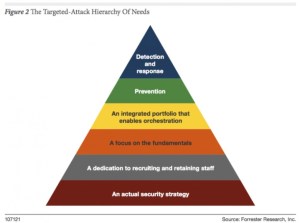
Forrester's Targeted-attack Hierarchy of Needs

Forrester’s Targeted-attack Hierarchy of Needs

Bruce Schneier’s recent post on Al Qaeda’s efforts to create their own encryption software had me shaking my head. They were making a very fundamental error that a lot of companies also make, even though Al Qaeda isn’t organized in a corporate fashion.

Forrester’s recently published Targeted-attack Hierarchy of Needs perfectly illustrates the Al Qaeda error and one that your corporation may be making in addressing security issues.

Can Al Qaeda (or your corporation) develop encryption that is unbreakable by the NSA, GCHQ, or China’s National Security Committee? I’m not very optimistic, even though they (or you) might have some very smart cryptologists on staff. As Schneier points out, open-source solutions have the advantage of study by anybody who cares to take the time to do so. As the flaws are found over time, the risk of a major undiscovered bug goes down. (Although certainly not to zero, as we’ve seen in Heartbleed.)

Al Qaeda’s error lies in prevention without a focus on the fundamentals and a security strategy. It’s a direct result of the “problem/solution” problem.


The Fundamental Mistake: Leaping Into Action

Al Qaeda needs to continue to operate, but they’ve learned that basically every communication channel they use short of cuneiform clay tablets has been compromised by the NSA and other security agencies. The response appears to have been “Action!” Again, a very corporate approach to the problem.

If developing their own encryption algorithms is indeed what they are doing, they’re operating at the Prevention level of Forrester’s pyramid.  It’s the same thing a lot of companies do. Add more hardware, do deep packet inspection of everything coming in and out of your network, and then have your IP walk out the door via a low-tech social engineering  effort.

I’m pretty sure Al Qaeda doesn’t have the trained PhD level cryptologists and software engineers to go head-to-head with national security agencies, nor the infrastructure to implement whatever they develop. You should ask yourself–does your company?


What Does This Have to Do With Marketing?

The mistake of leaping into action happens a lot in marketing. It’s easier to make the mistake because marketing (usually) doesn’t include complicated mathematics. I call the situation the “problem/solution” problem. Many times you’ll be in a meeting to discuss a problem. Even if it’s not on the agenda, the meeting devolves into a solution-finding meeting.

Even if the problem isn’t completely defined or agreement that there is, in fact, a problem.

You have to start with the fundamentals and work your way up. Don’t dawdle, of course. But jump to conclusions about the solution and you’ll find yourself solving the wrong problem.

Just like Al Qaeda, who should probably be putting most of their focus on old, non-digital communication channels instead of trying to out-encrypt the NSA.

What’s next? I’ve got a few posts on how the scientific method works in marketing and how the proper use of the same methodology you learned in 7th grade will make your marketing more focused and efficient.



Posted in Marketing, Privacy, Security, Strategy | Tagged , , , , , , , | Comments Off on We Need Action, Not Strategy, Said No Security Expert Ever